


Economy
It was the moment we'd all been waiting for. On Wednesday the Federal Reserve announced it was cutting interest rates by 0.5%. Between March 2020 and March 2022, the Fed held rates at 0%. As inflation crept in following the pandemic, the Fed began raising rates on March16, 2022, ultimately bringing it's target rate from 0% to 5.25% by July 2023. Rates remained there until this week. The rate cut we saw this week can be interpreted as both the Fed declaring victory over inflation (the consumer price index is currently at 2.5%) as well as the Fed being aware that the economy is slowing (the unemployment rate has risen from 3.4% to 4.2% over the last year).
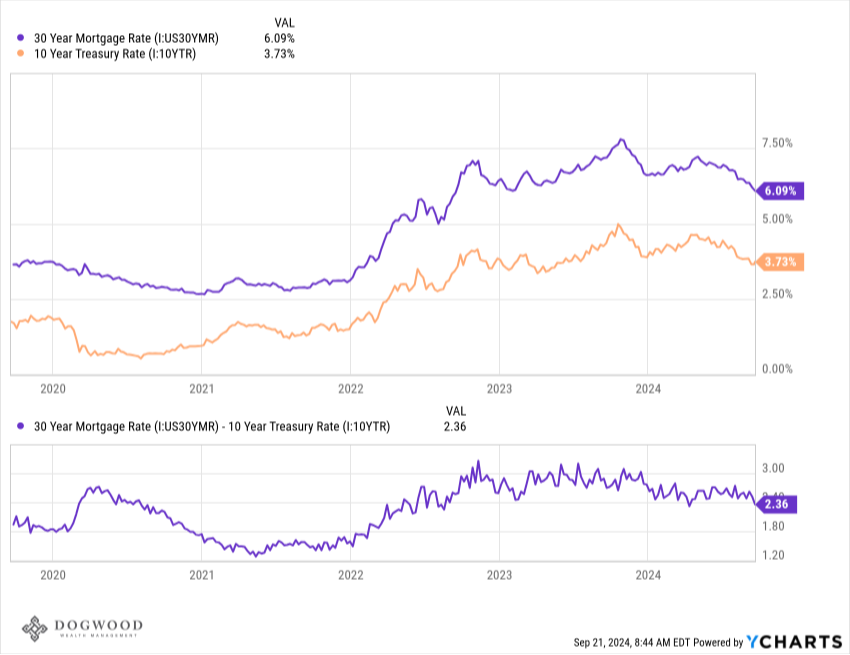
There are two more scheduled meetings for the Fed in 2024, (November 7 and December 18). The market is currently pricing 50/50 odds of either a 0.25% or a 0.5% cut in November. Jerome Powell, speaking at a press conference Wednesday, made clear we are not going back to 0% rates. Because the rate cut was so widely expected, we've seen longer rates (bonds, CD's, auto loans, mortgages, etc.) declining for weeks now. Don't expect a 1-for-1 move on longer rates as the Fed continues to lower it's rate. You can, however, expect that rates on the shorter end (high yield savings accounts, money markets, etc.) to come down over the next several months. The big questions with interest rates now is 1) where will the Fed end up at the end of this rate cut campaign and 2) how quickly will we get there. If we aren't going back to Zero Interest Rate Policy (ZIRP), do we instead arrive in a world where the Fed's rate is somewhere around, say 2.5-3%? And do we get to that point before cracks in the economy begin to emerge? Looking ahead to 2025, the market is expecting the Fed to continue lowering rates through next year and get them below 3%.
Markets
While the market was sure that rates would be cut this week, what wasn't so sure was the extent of the cut. Going in to Wednesday, there were close to 50/50 odds of the first cut being either 0.25% or 0.5%. The market's initial reaction to the 0.5% cut was a bit perplexing. We saw an initial jump higher followed by choppiness for the rest of the afternoon on Wednesday, with the markets finally ending flat for the day. I suppose you could look at Wednesday's close, shrug your shoulders, and conclude that the market had fully priced in a 0.5% cut. Then, for whatever reason, the markets ripped higher Thursday, setting new all-time highs. Perhaps it wasn't fully priced in after all. For the week, the S&P 500 rose 1.36%.
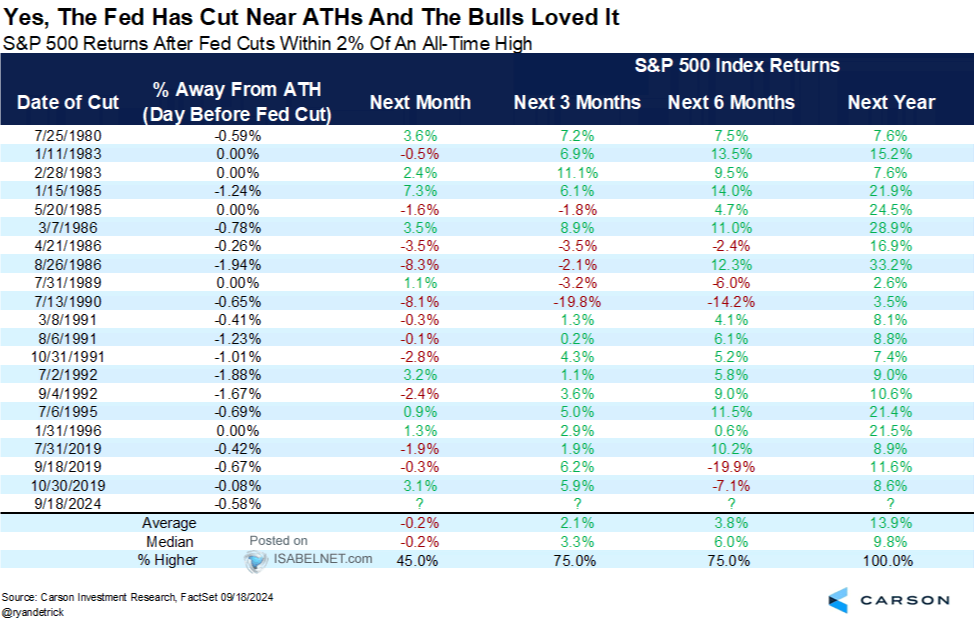
Sometimes when the Fed is bringing rates down, it can mean less-than-stellar returns for the stock market. That's usually because when the economy is in rough shape, the Fed will lower rates to stimulate growth. However, there have been periods where the Fed is cutting rates in a health economy. Those periods may be a better analog (although not perfect) to today's environment. The Carson Group found that there have been 20 times since 1980 that the Fed issued a rate cut with the market within 2% of an all-time high. In all 20 previous examples, the market was higher 12 months later, with an average return of nearly 14%. This is not a guarantee of what's to come over the next year, but it is an interesting data point.
What We're Reading
- Taxes, the Election, and What It Means For Investors - Dogwood Wealth Management
- Why Insuring Star Players Has Become a Source of NFL Tension - ESPN
Have a great weekend.
Dogwood Wealth Management