 | |||
Keeping Retirement on Track in a Rocky EconomyApril 9, 2025 | |||
Global financial markets are experiencing heightened uncertainty due to escalating trade tensions. With China implementing counter-tariffs in response to U.S. measures, investors worldwide are growing increasingly concerned about recession risks. This environment has triggered market declines across Asia, Europe, and the United States, while pushing investors toward safer assets like bonds. Strategic portfolio management becomes crucial in uncertain times
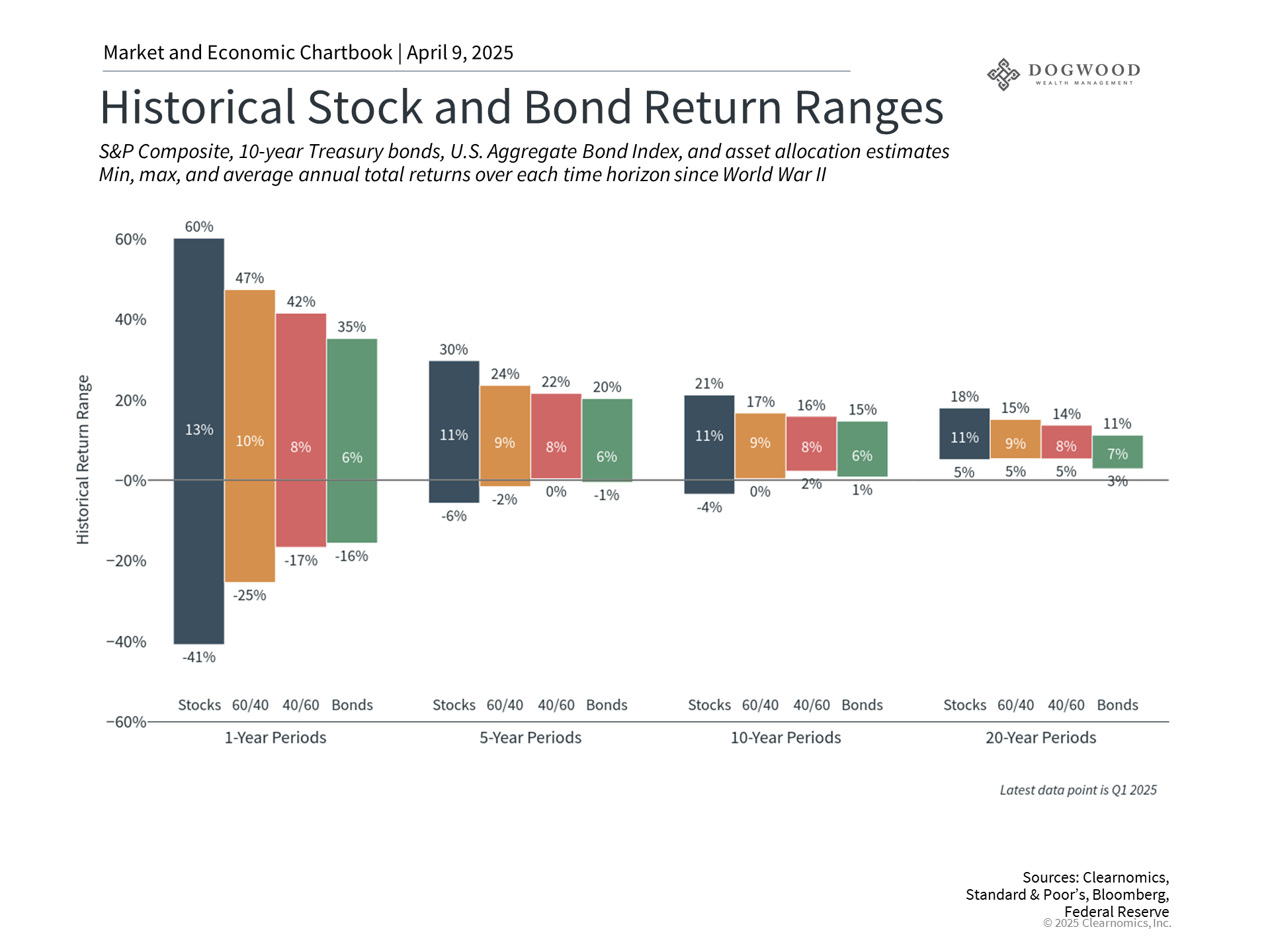
Success in both investing and athletics requires mastering both defensive and offensive strategies. Defensive investing means building a resilient portfolio that can weather various market conditions. Given the inevitability of market volatility and unexpected events, maintaining strong defenses is essential. Offensive investing involves capitalizing on opportunities that emerge during market shifts. While market uncertainty can be unsettling, these periods often present some of the most attractive valuations. A well-designed portfolio needs both defensive protection and offensive potential to achieve long-term financial objectives. The question is: how can investors optimize their positioning in the current environment? Diversification and long-term perspective represent cornerstone principles of successful investing. The accompanying visualization demonstrates historical performance ranges across various asset types and portfolio combinations over different time periods. For example, single-year stock market returns have ranged from a positive 60% in 1983 following stagflation concerns to negative 41% during the 2008 financial crisis. Examining longer time horizons and mixed portfolios reveals the power of these investment principles. While diversification may limit maximum potential returns, it significantly reduces risk exposure. This is demonstrated by the balanced 60% stocks/40% bonds portfolio. While the S&P 500 has declined 13% this year, a 60/40 portfolio has only fallen 4.6%. The primary objective isn't maximizing returns at any cost, but rather achieving financial goals with the highest probability of success. Diversified portfolios historically show more consistent outcomes, enabling more reliable financial planning. Time horizon extension can dramatically impact investment outcomes. Since World War II, there hasn't been a single 20-year period where these portfolio combinations experienced average annual losses. This pattern holds true over 10-year periods for many diversified allocations. While past performance doesn't guarantee future results, this clearly demonstrates the benefits of long-term investing. Market turbulence can present compelling investment possibilities
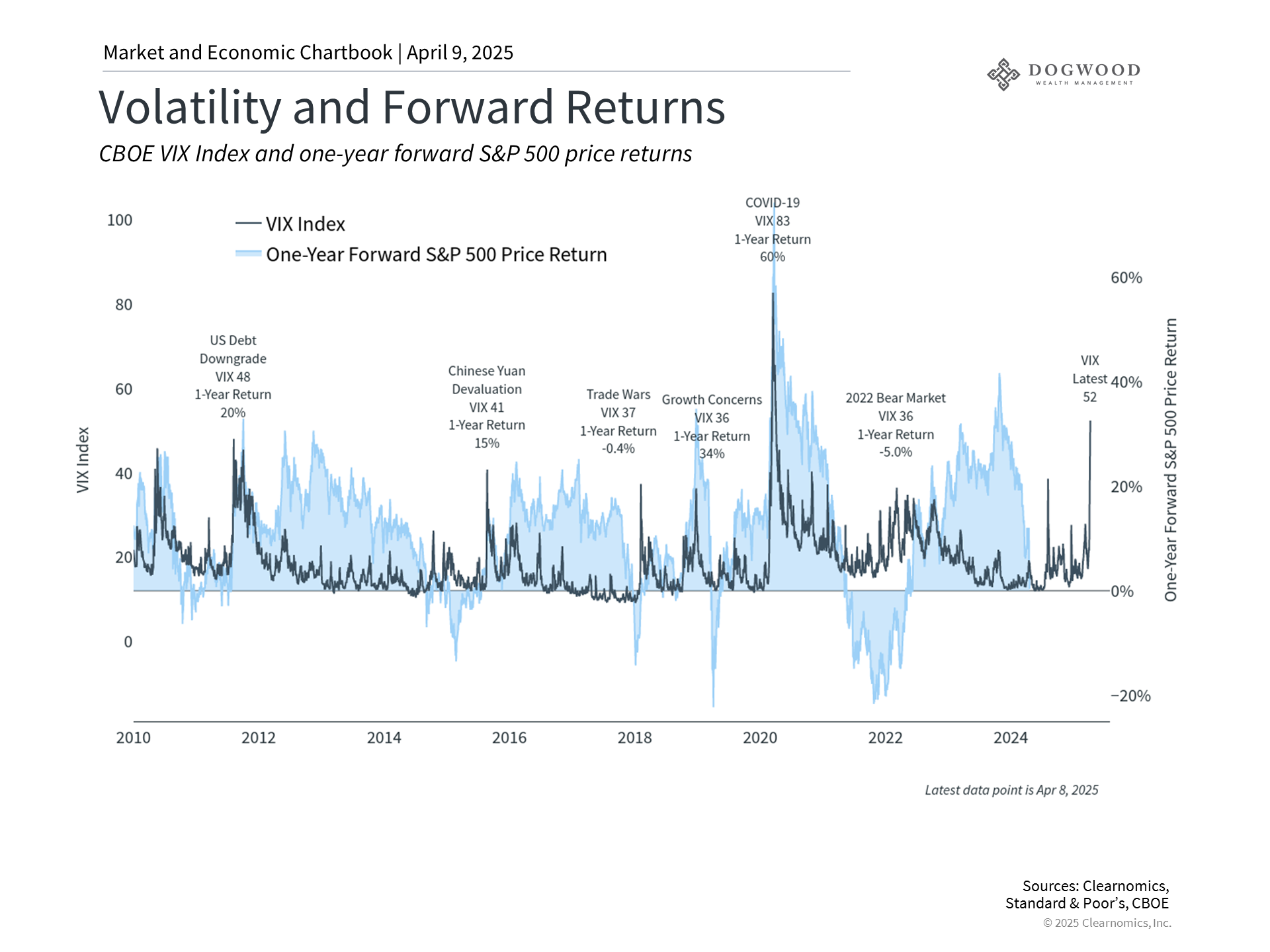
The VIX index, commonly referred to as the market's "fear gauge," typically spikes during periods of market stress. These peaks align with significant market drawdowns, like those seen in 2008 and 2020. During these periods, market sentiment often reaches extreme pessimism, with many doubting the possibility of recovery. The chart also displays subsequent 12-month S&P 500 returns following these VIX spikes. While no single-year return is guaranteed, history suggests that the most attractive opportunities often emerge during periods of peak market fear. This observation aligns with Warren Buffett's famous advice to "be fearful when others are greedy, and greedy when others are fearful." This pattern is particularly relevant when markets face liquidity rather than solvency challenges. Liquidity issues arise when market declines force leveraged investors to sell assets. These situations can create disconnects between short-term prices and long-term fundamentals, potentially benefiting patient investors. This shouldn't be interpreted as an endorsement of market timing. Even elevated VIX levels don't guarantee immediate market recoveries. Rather, investors should view this through a portfolio management lens. Market corrections often coincide with attractive valuations, potentially warranting selective increases in exposure to affected assets. However, specific portfolio decisions should always align with individual circumstances. Market conditions have created more favorable valuations
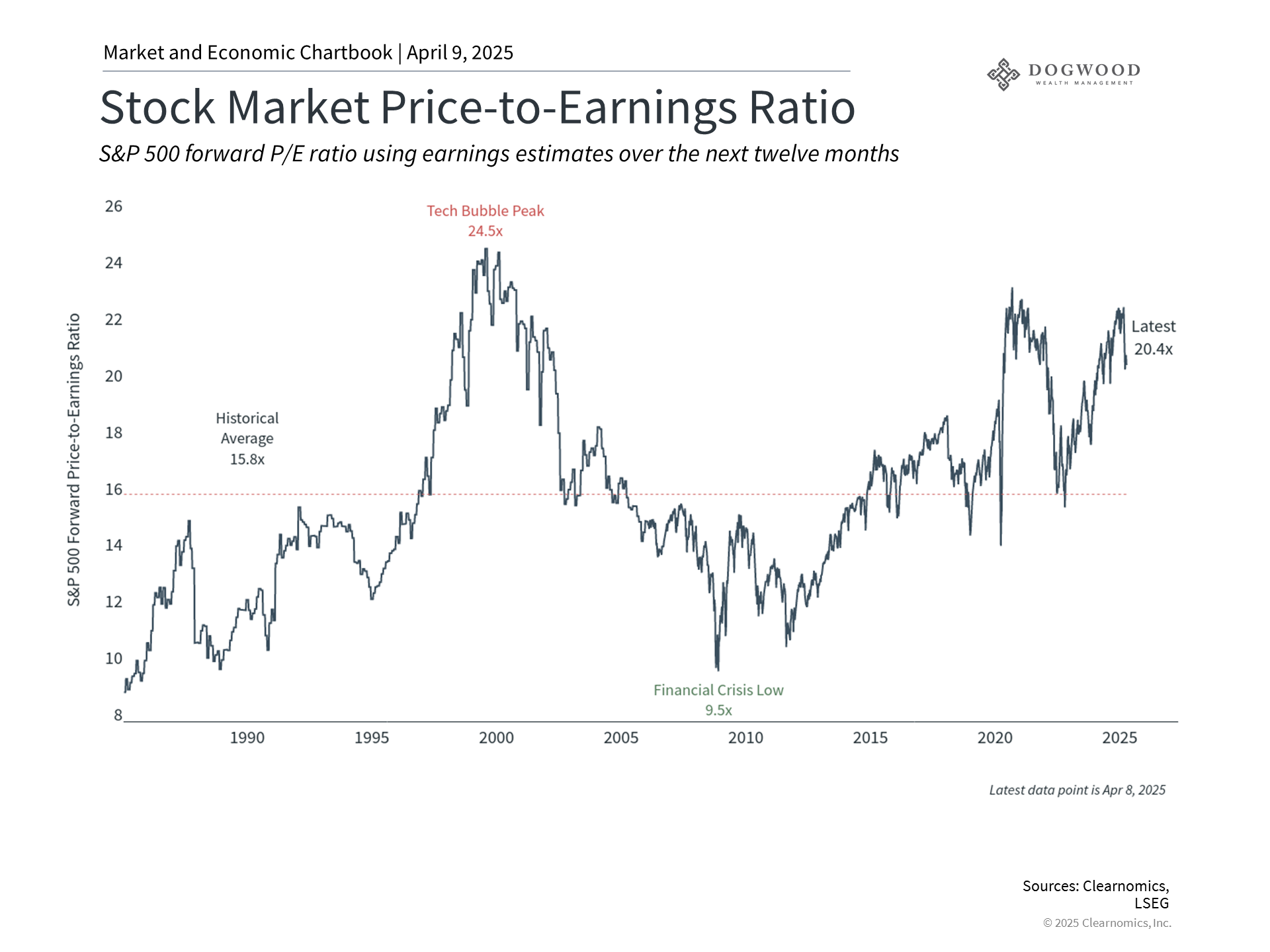
Bonds have demonstrated their portfolio stabilizing properties this year as falling interest rates have helped offset declines in other assets. This illustrates bonds' typically lower volatility and tendency to move inversely to stocks - the "zig when stocks zag" phenomenon. This relationship makes properly balanced uncorrelated assets valuable for portfolio resilience. Following several years of strong equity market performance, valuations have become more reasonable. While the impact of tariffs on earnings remains uncertain, the S&P 500's price-to-earnings ratio has decreased to 20.7x. Several sectors, including Information Technology, Communication Services, and Consumer Discretionary, have experienced even larger multiple contractions during the broader market retreat. Traditional safe-haven assets like gold have shown mixed performance recently. Despite reaching record highs earlier this year and delivering double-digit returns over the past twelve months, gold prices have retreated amid broader commodity market weakness. This underscores the importance of maintaining a diversified portfolio rather than concentrating on any single asset class. The bottom line? Successfully navigating market uncertainty requires both defensive positioning and offensive readiness. This dual approach helps manage risks while allowing investors to capitalize on opportunities that emerge during periods of market stress. Maintaining an appropriately balanced portfolio remains the most effective path to long-term financial success. Want help adjusting your retirement strategy for today’s market? Schedule a free consultation to discuss how to keep your retirement goals on track — no matter what the market is doing. | |||
Dogwood Wealth Management, LLC. ("Dogwood") is a Registered Investment Advisor ("RIA") with the U.S. Securities and Exchange Commission (“SEC”). Dogwood provides investment advisory and related services for clients nationally. Dogwood will maintain all applicable registrations, notice filings, and licenses as required by the various states in which Dogwood conducts business, as applicable. Dogwood renders individualized responses to persons in a particular state only after complying with all regulatory requirements, or pursuant to an applicable state exemption or exclusion. |

Keeping Retirement on Track in a Rocky Economy