


The first half of 2025 presented no shortage of challenges for investors. From a renewed trade war and market corrections to escalating conflict in the Middle East and mounting concerns over the national debt, it has often felt like markets are lurching from one crisis to another. Headlines filled with pessimism have only added to the sense of instability, amplifying investor anxiety.
Yet, as the old adage goes, never let a good crisis go to waste. While the phrase is typically used in politics, its relevance to investing is just as strong. Beneath the surface-level noise, periods of volatility often present compelling opportunities for disciplined investors. Despite pullbacks in the S&P 500 and Dow, and a bear market in the Nasdaq, the first half of the year also featured one of the swiftest rebounds in recent memory.
This dynamic rewarded those who stayed focused on their long-term strategies, maintained appropriate asset allocations, and resisted the urge to react to each headline. Risk and reward are inherently linked—uncertainty may be uncomfortable, but it is also what creates the potential for future returns. If staying invested during turbulent times were easy, the rewards would likely be far smaller.
As we enter the second half of the year, it's critical to remember these lessons. Below, we highlight five key insights to help investors navigate today's environment and stay positioned for opportunity—regardless of what the headlines may bring.
 |
Geopolitical Risks Are Dominating Headlines—But Markets Remain Forward-Looking
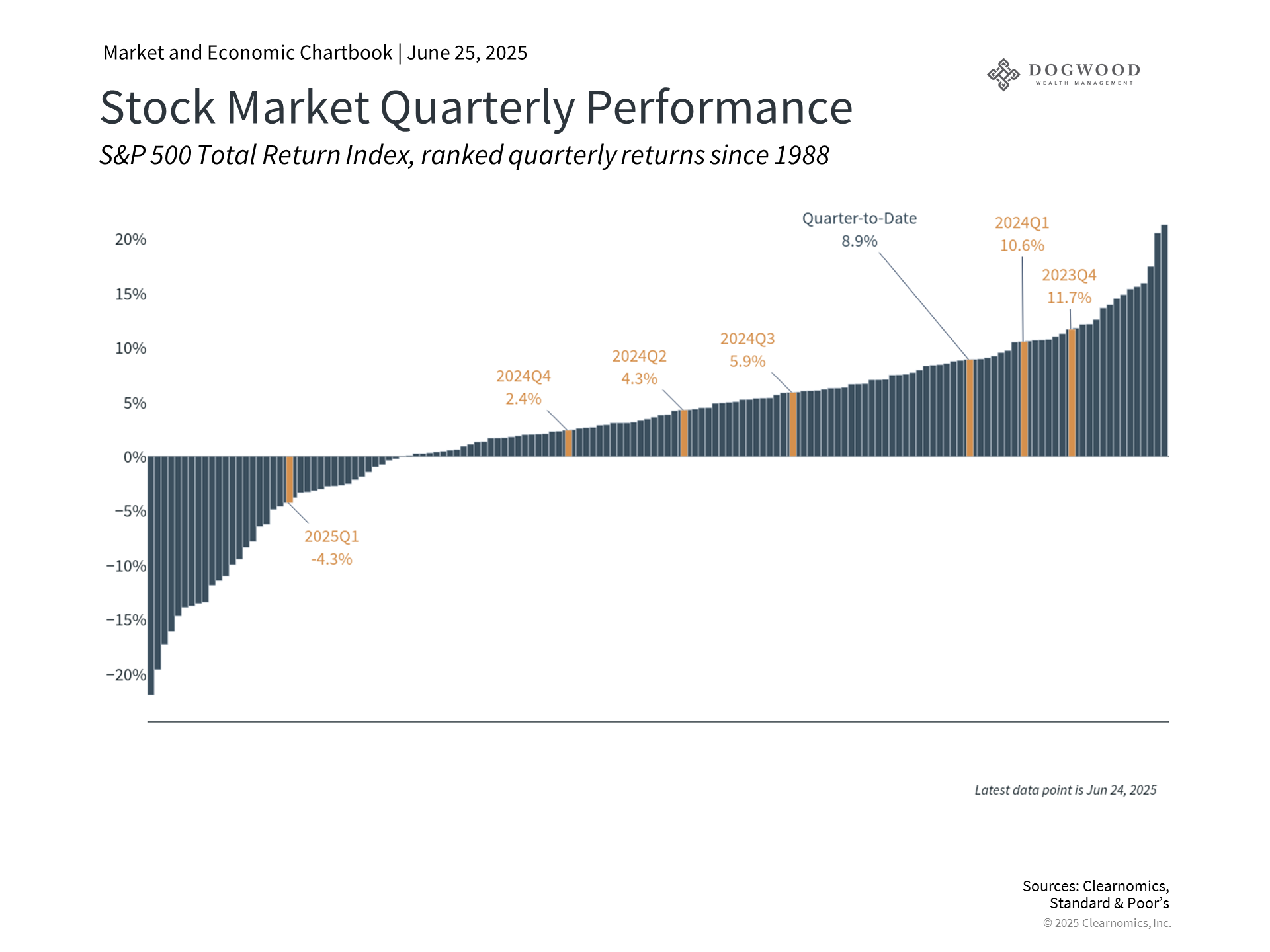
Investors have grown accustomed to volatility in recent years, and 2025 has been no exception. Concerns of a prolonged trade war and the threat of a global recession weighed heavily on sentiment earlier this year.
While tariffs remain a headwind, recent trade agreements have eased some of the most alarming fears. As the accompanying chart shows, markets rebounded meaningfully in the second quarter as the likelihood of worst-case scenarios diminished.
Looking ahead, investor attention will likely remain focused on the next phase of trade negotiations. Temporary tariff pauses for many countries are set to expire in July, and a finalized deal with China has yet to materialize. That said, the administration appears committed to securing new agreements, echoing the trade dynamics of 2018 and 2019. Still, the overall level of tariffs has increased this year, which may continue to pressure consumer prices and corporate margins.
As we enter the second half of 2025, it’s important to stay grounded in the fundamentals. Market recoveries are never guaranteed—but markets are forward-looking and remarkably adaptive. By focusing on long-term trends rather than short-term headlines, investors can better navigate uncertainty and uncover opportunity.
 |
Geopolitical Tensions Are Rising, but Markets Remain Focused on Fundamentals
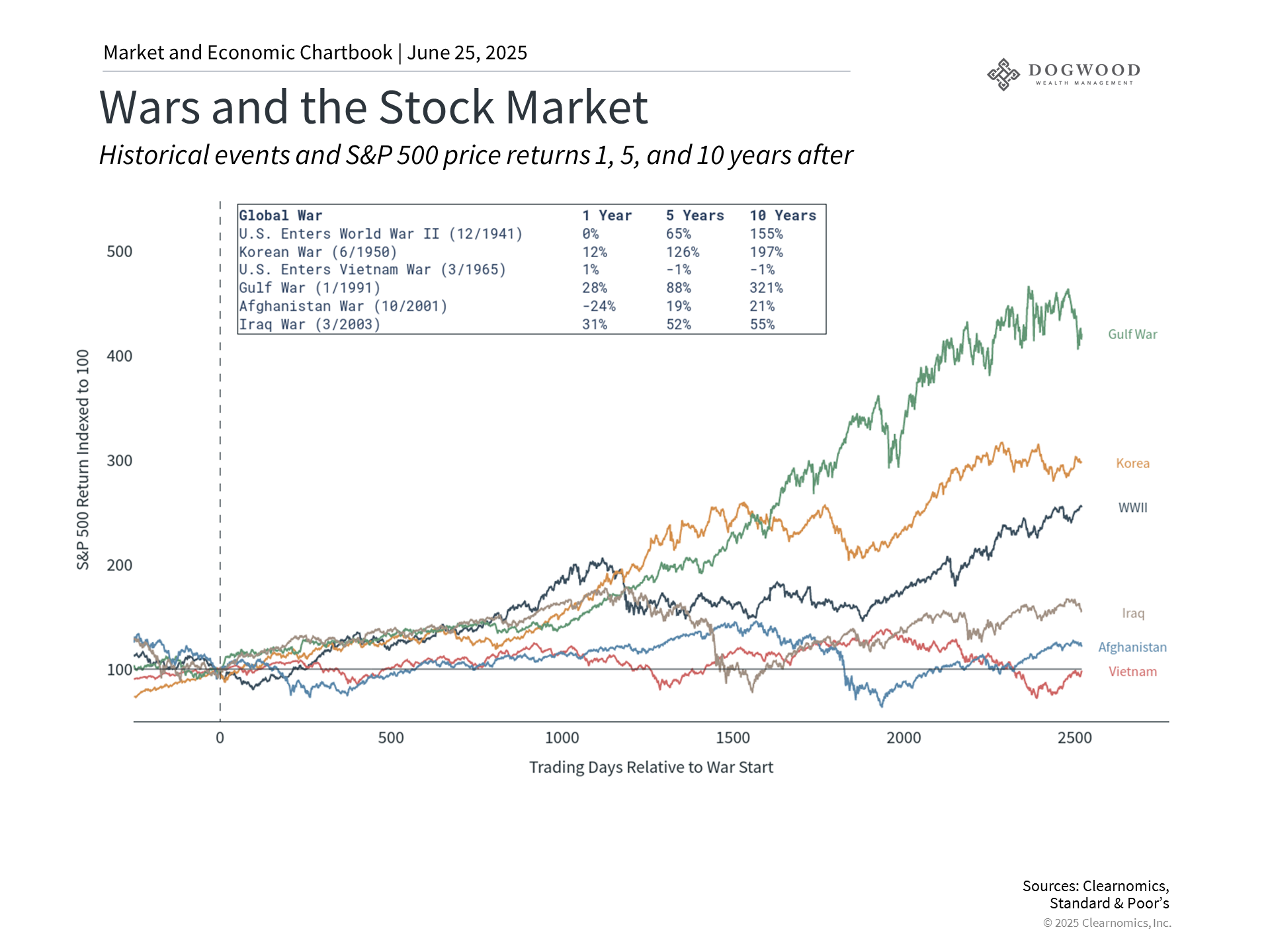
Geopolitical risks have escalated in recent months, particularly with the intensification of the Israel-Iran conflict and the growing involvement of U.S. military forces. These developments naturally raise investor concerns, as such events fall outside the typical scope of economic or corporate news. However, history offers a valuable perspective on how markets tend to respond to geopolitical shocks.
As the accompanying chart illustrates, markets have historically recovered from geopolitical disruptions—often within months of the initial event. Even major conflicts and wars have had limited long-term impact on well-diversified portfolios. This is not to discount the human and societal toll of these crises, but to highlight that reactive portfolio decisions driven by geopolitics are rarely effective.
What has mattered more over time are the broader economic and market trends. For instance, the Gulf War occurred during a robust bull market in the 1990s, fueled by the rise of information technology. The war in Afghanistan, by contrast, began in the aftermath of the dot-com collapse and spanned multiple economic cycles. Similarly, while World War II helped catalyze industrial expansion as the U.S. emerged from the Great Depression, the Vietnam War coincided with an era of stagflation and weaker market performance.
Today’s concerns center on the risk of oil supply disruptions, particularly through the Strait of Hormuz—a strategic chokepoint for more than 20% of the world’s oil transport. Any interruption could pressure global energy prices and stoke inflationary concerns.
Yet, despite the heightened geopolitical tension, oil prices have remained relatively stable. Brent crude is trading near levels seen earlier this year, suggesting markets are taking a measured view of the situation—at least for now.
In short, while geopolitical risks remain a key variable, the broader economic picture remains relatively healthy. Staying focused on long-term fundamentals rather than short-term headlines is essential to navigating periods like this with discipline and perspective.
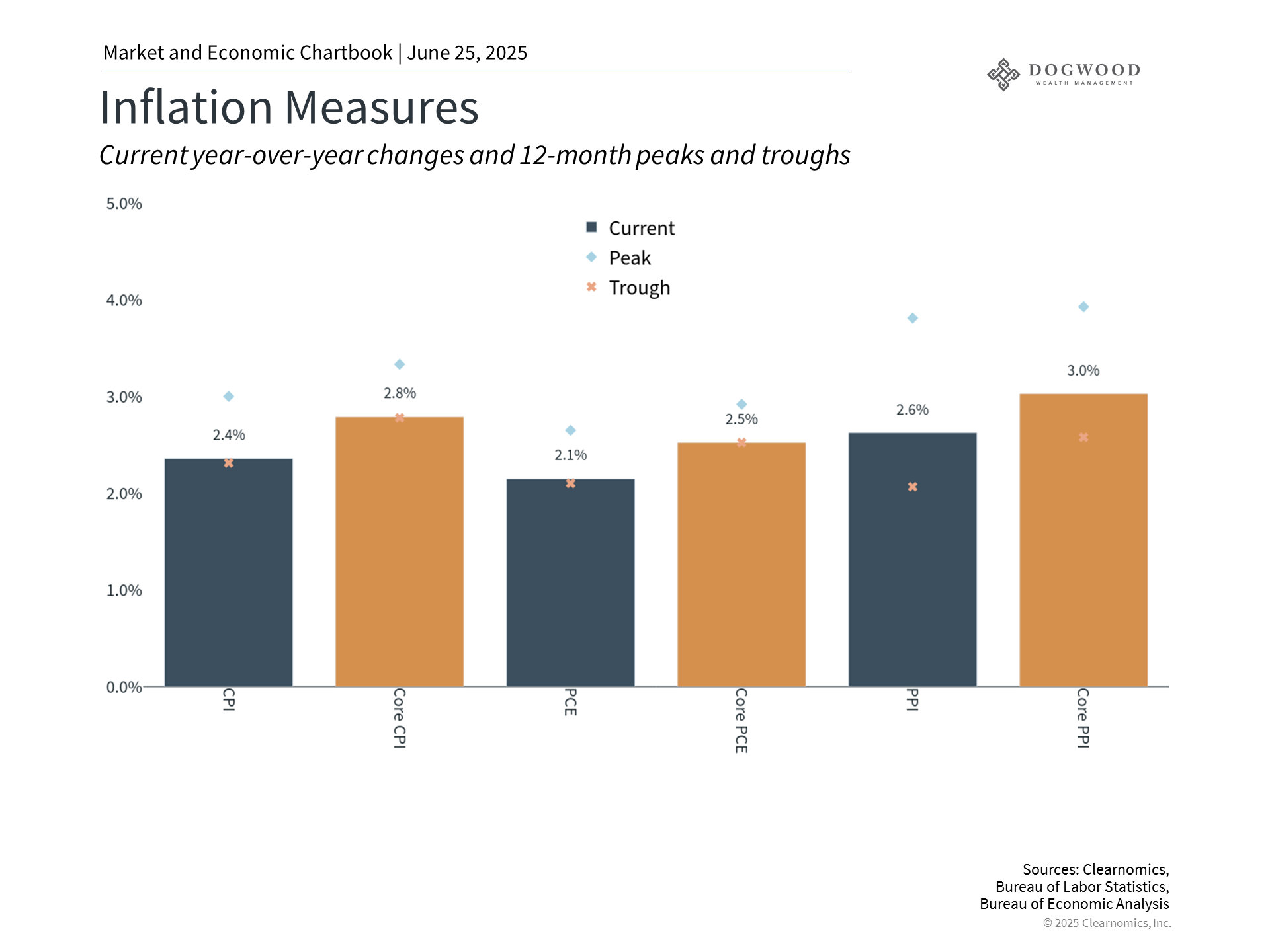 |
One of the most encouraging developments in recent years has been the continued strength and resilience of the U.S. economy. Perhaps most surprising to investors is the robust labor market, which has held up even as inflation has gradually declined toward more historically normal levels. As the accompanying chart illustrates, many inflation measures have now fallen below 3%.
While the most recent GDP report showed a slight contraction of 0.2% in the first quarter, a closer look reveals that much of this was driven by trade-related factors. Specifically, businesses front-loaded imports in anticipation of potential new tariffs, temporarily distorting trade balances. In contrast, consumer spending—the backbone of the U.S. economy—continued to grow at a steady pace. Stripping out the trade component, the economy likely would have posted positive growth.
Looking ahead, one issue that may return to the forefront in the second half of the year is the growing national debt. Persistent government spending and ongoing deficits have led to mounting concerns, culminating in Moody’s decision to downgrade U.S. debt in May. This follows similar actions by Standard & Poor’s in 2011 and Fitch in 2023. As Congress prepares to debate the next budget, including the potential extension of provisions from the Tax Cuts and Jobs Act, fiscal policy may again dominate headlines.
There’s no doubt the rising national debt poses significant long-term risks. But when it comes to managing portfolios, it’s important to keep perspective. Historically, making drastic investment decisions based on the political or fiscal climate in Washington has rarely paid off. In fact, these periods often create opportunities across asset classes, particularly in both equity and fixed income markets.
Economic Resilience Remains a Bright Spot—Despite Headline Risks
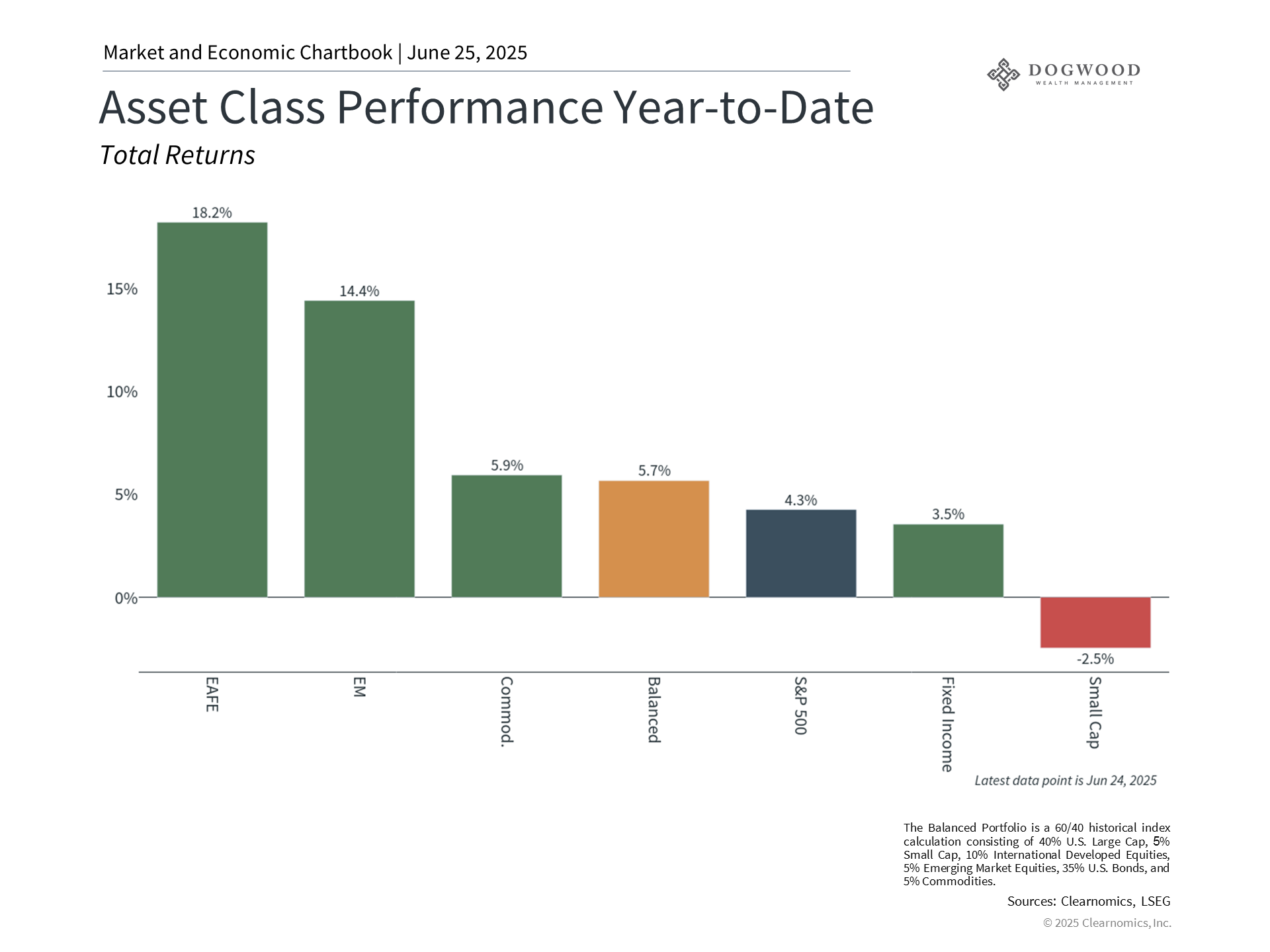 |
One of the key challenges accompanying the recent market rebound is that U.S. stock valuations have once again climbed to elevated levels. While this may limit near-term upside for some domestic equities, it also creates opportunities in other parts of the market. Areas such as international equities, small-cap stocks, and value-oriented sectors continue to trade at more attractive valuations—offering potential for long-term investors willing to be patient. Additionally, bond markets remain appealing, with yields still above historical averages across most fixed income categories.
One of the standout stories of 2025 has been the resurgence of international markets. Both developed and emerging market equities, as represented by the MSCI EAFE and MSCI EM indices, have delivered strong double-digit returns year-to-date. A major factor behind this performance has been the weakening U.S. dollar, which tends to boost the value of foreign-denominated assets.
This trend underscores an important principle for the second half of the year: market leadership is never static. It shifts over time, often in ways that are difficult to predict. By maintaining diversified exposure across regions and asset classes, investors can improve long-term outcomes while managing risk more effectively.
While no strategy can guarantee results, the current environment is a strong reminder of the value of staying globally diversified and committed to a long-term plan—especially during periods of shifting market dynamics.
The Benefits of Maintaining a Long-Term Perspective
 |
Staying Focused on the Long Run
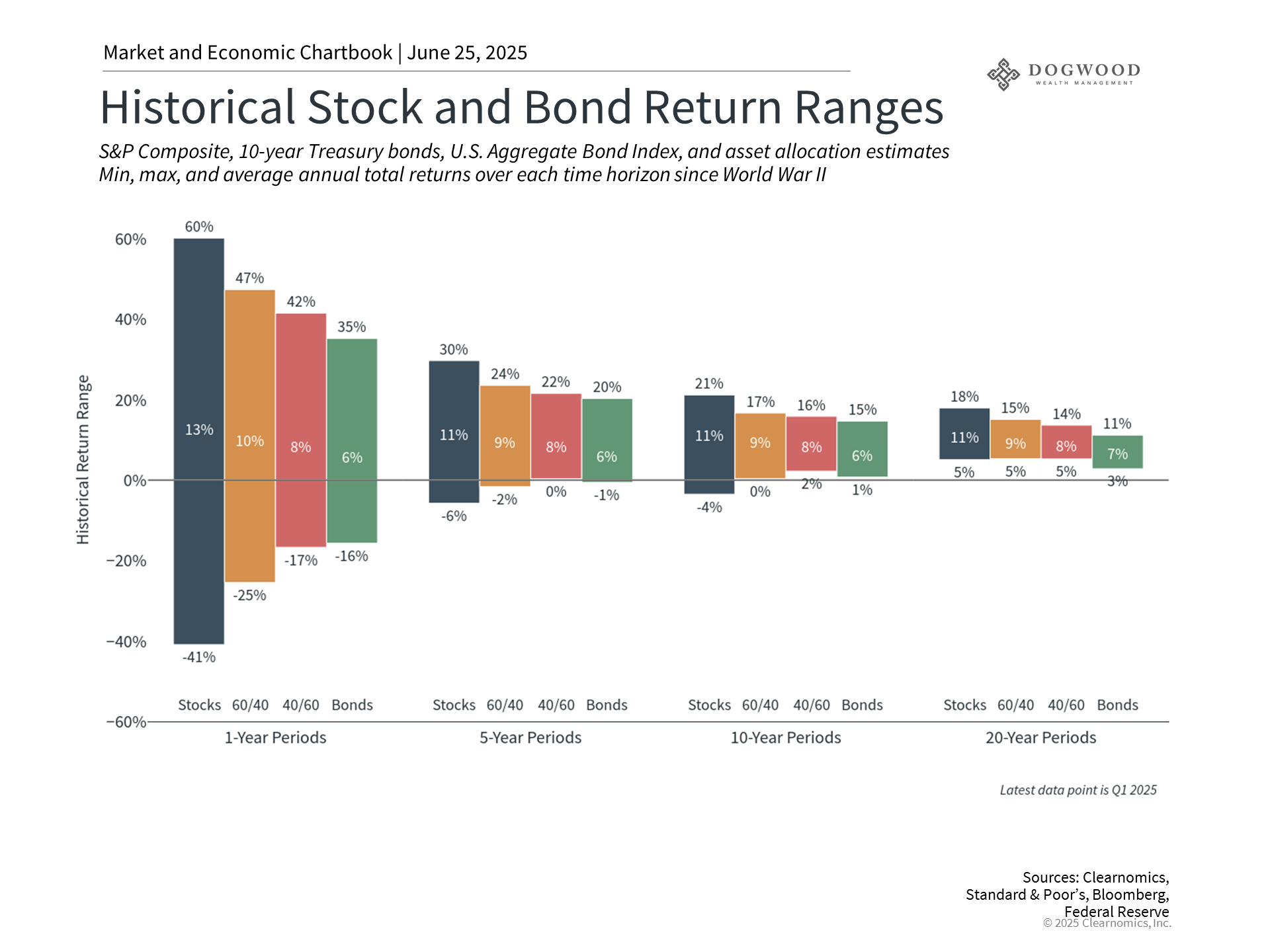
The patterns we’ve seen in the first half of 2025 are not new. History shows that challenging market environments are a recurring feature of investing—and that extending your investment time horizon is one of the most effective ways to improve long-term outcomes.
The accompanying chart highlights this clearly: while annual stock returns can swing dramatically from losses to gains, these short-term fluctuations tend to smooth out over longer periods. Over 10 years or more, the range of returns narrows significantly, which is why equities and bonds have remained the cornerstones of long-term portfolios.
This perspective reinforces a timeless principle: staying committed to a well-diversified, thoughtfully constructed portfolio is critical—especially during periods of uncertainty. As new developments continue to shape markets in the months ahead, this discipline will be more important than ever.
The bottom line? The first half of 2025 is a powerful reminder of the value of long-term thinking. Investors who stay focused on enduring principles rather than short-term noise are best positioned to navigate what lies ahead and stay on track toward their financial goals.